Showing posts with label Interpretation. Show all posts
Showing posts with label Interpretation. Show all posts
Sunday, October 21, 2018

Saturday, September 15, 2012
Interpretare consecutivă din germană la Primăria Braşov
Interpretare consecutivă din germană - Primăria Braşov 15.02.2012 - Înfrăţire între oraşul Braşov din România şi oraşul Linz din Austria
Konsekutivdolmetschen aus dem Deutschen ins Rumänische – Rathaus der Stadt Braşov 15.02.2012 – Partnerschaft zwischen der Stadt Braşov aus Rumänien und der Stadt Linz aus Österreich
Konsekutivdolmetschen aus dem Deutschen ins Rumänische – Rathaus der Stadt Braşov 15.02.2012 – Partnerschaft zwischen der Stadt Braşov aus Rumänien und der Stadt Linz aus Österreich

Sunday, June 24, 2012
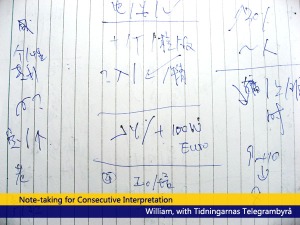
Note Taking in Consecutive Interpreting
1. Introduction
1. 1 What is Interpreting?
Interpretation occurs during cross-cultural communication when two interlocutors do not share a language. By bridging the gap between languages, the interpreter helps speakers to discharge their duty to make themselves understood and helps listeners to satisfy their need to understand what is being said. The goal of interpretation is that a message makes the same impact on the target audience that a speaker/signer intends for an audience of her/his same language. Communication involves intention, context, form, gist, gesture, tone, relations of power, etc. The different situations where interpretation takes place make very different demands of the interpreter.
Interpretation requires superior language ability in at least two languages. It also requires the ability to accurately express information in the target language. Besides deep knowledge of both languages, it is crucial that an interpreter also understands the subject matter of the text or speech he is interpreting. Interpretation is not a matter of substituting words in one language for words in another. It is a matter of understanding the thought expressed in one language and then explaining it using the resources and cultural nuances of another language, so they can express the source text or speech so that it sounds natural in the target language. The interpreter relies mainly on the ability to get the gist of the message across to the target audience on the spot as an interpreter is expected to convey the essence of the message immediately in satisfactory paraphrase or a rough equivalent in order not to keep the audience waiting.
1.2 Modes of Interpreting
According to Hatim and Mason (1997: 36), there are three principal modes of interpreting: simultaneous, consecutive and the liaison. Those are inevitably place different demands on the interpreter
a. Simultaneous
This mode is considered a harder mode of interpreting and involves the interpreter continuously interpreting from the source language into the target language as the source speaker is speaking.
Simultaneous interpreting is rendering an interpretation continuously at the same time someone is speaking. Simultaneous interpreting is intended to be heard only by the person receiving the interpretation and is usually accomplished by speaking in whispered tones or using equipment specially designed for the purpose in order to be as unobtrusive as possible. It is usually used in a conference or in a big seminar.
According to Seleskovitch (1978:125) in Mikkelson (1998), in simultaneous interpretation the interpreter is isolated in a booth. He speaks at the same time as the speaker and therefore has no need to memorize or jot down what is said. Moreover, the processes of analysis-comprehension and of reconstruction-expression are telescoped. The interpreter works on the message bit by bit, giving the portion he has understood while analyzing and assimilating the next idea.
Because of the short time frame and the complexity of language, a simultaneous interpreter must be quick-thinking and decide on the most likely interpretation and follow it through. To spend unnecessary time agonizing over the speaker`s phrasing could amount to losing important information in the next sentence.
According to Hatim and Mason (1997 : 45), texture comes to the fore in simultaneous interpreting. The term texture refers to various linguistic devices applied in a text with a purpose to build a flow of sense and to make a sequence of sentence operational or what are said as cohesive and coherence. In simultaneous interpreting, the interpreter should react and interact from one utterance to other utterance where overlapping between various element of sequence is unavoidable. It is impossible to get the whole structure nor the context of a text in simultaneous interpreting, As an anticipating strategy, an interpreter should pay attention on the variety of cohesive devices used in the text as a reference as texture provides the interpreter with “a point of departure” that enable him to be able to follow the sequence or the flow of the text
b. Consecutive
Unlike the simultaneous interpreting where the interpreter has at least something to embark upon, the consecutive interpreter has to wait before he/she can deliver the output text. It means that it will add pressure and extra load on memory, which results that information related to texture and context become rather too detail to hold.
According to Hatim and Mason (1997: 42), consecutive interpreter, whose output comes after the source text has been delivered, tends to focus on information relevant to text structure. Effective consecutive output thus exhibits a clear outline of the way the text is structured.
Further discussion about consecutive interpreting will be presented on the next section
c. Liaison
Liaison interpreting is a very common form of interpreting and takes place in a range of different situations ranging from very formal contexts, such as business or talks between heads of state to less formal situations such as work visits, parties or even casual conversation between people who do not share the same language.
Liaison interpreting is a facilitation work. The interpreter finds for each situation the best way to establish fluid and harmonious communication between the parties. Sensibility, perception, top-notch communication and interpersonal skills are paramount to a quality liaison, greatly contributing to the parties’ fruitful negotiation.
Liaison interpreting involves relaying what is spoken to one, between two, or among many people. This can be done after a short speech, or consecutively, sentence-by-sentence, or as a whispering; aside from notes taken at the time, no equipment is used.
The liaison interpreter has access only to a partial view of texture and structure, both of which would be unfolding piece meal in the two way exchange. In this case, context would seem to be the main resource which the interpreter draws on in the task of maintaining the continuity of the exchange. (Hatim and Mason, 1997:41)
2. CONSECUTIVE INTERPRETING
As what has been stated in the previous section, consecutive interpretation is a mode in which the interpreter begins their interpretation of a complete message after the speaker has stopped producing the source utterance. At the time that the interpretation is rendered the interpreter is the only person in the communication environment who is producing a message. Good memory is a prerequisite of good interpreting. Memory in consecutive interpreting refers to the capacity for storing and retrieving information of the interpreter. Many people say that although they can understand the message the speaker is delivering, they find it difficult to commite content of the message to their memory. As a result, it is impossible for them to interpret what has no longer been retained in their mind into a different language. Then the major problem here is how to supplement the memory for consecutive interpreting. And the solution to the problem is to acquire note-taking skill. Notes can serve as an effective aid to the memory of the interpreter but they can never replace the role of memory. A basic principle for successful consecutive interpreting is that memory comes first and notes function to support it. Target language reproduction should not be based on notes only but on the combination of memory and notes.
2.1 Consecutive Interpreting As A Cognitive Process
In order to be able to interpret a text the interpreter must be able to receive and understand the incoming message and then express its meaning in the target language. In order to accomplish this task, the interpreter must go through an overlapping series of cognitive processing activities. These include: attending to the message, concentrating on the task at hand, remembering the message, comprehending the meaning of the message, analyzing the message for meaning, visualizing the message nonverbally, and finally reformulating the message in the target language
Seleskovitch, among others, points out that there is another practical reason for the interpreter to discard the form of the source text, there is only so much that a person can hold in their short-term memory. As the interpreter receives the source text the information passes initially through their short-term memory. If the interpreter does not do anything with this information it will soon disappear. Smith (1985 : 38) notes that, “Short term memory has a very limited duration. We can remember six or seven items only as long as we give all of our attention to them”. If an interpreter attempts to retain the form of a source utterance their short-term memory will be quickly filled with individual lexical items, which may not even compose a full sentence.
It is because of the limitations of short-term memory that interpreters are required to drop form and concentrate on meaning. Both Seleskovitch and Smith propose that meaningful segments of great size can be placed into long-term memory and retrieved later. Of course a chunk of information must be understood in order to be meaningful.
Due to the greater ease of assimilating larger meaningful chunks of information it force the interpreter to focus their attention on these larger chunks. A larger chunk of text will usually contain a greater amount of meaning. This relationship will help the interpreter to understand the source text when working consecutively
Interpreters are not charged with merely understanding the message, they must also be able to remember it, in order to deliver their interpretation. Seleskovitch notes that dropping form aids the interpreter’s memory because they are not concentrating on remembering the words, or even the structure of the source text. Instead, the interpreter understands the message, connects it to long-term memory, and is then able to reformulate it in much the same way the moviegoer can relate the points of a film. To this end interpreters working consecutively will often make notes as they take in the source utterance. These notes help the interpreter retrieve the message from their long-term memory and consist of, “symbols, arrows, and a key word here or there” (Seleskovitch, 1991 : 7). These few notes are effective because interpreters do not produce their target texts based on the form used by the speaker but on what they understood of the meaning of the source text. The “key words” may consist of words that will remind the interpreter of the speaker’s point, or of specific information “such as proper names, headings and certain numbers” (Seleskovitch, 1978 : 36). Taking note in consecutive interpreting will be discussed further in the next Section.
Wei HeZhong, in the article Memory Training in Interpreting views consecutive interpreting as a process consisting of two separable phases. The first phase is listening during which the interpreter listens to the sourcelanguage speech and takes notes; the second phase is reformulating, during which the interpreter reproduce a target-language speech from memory and from notes.
In this phase, the interpreter is required to listen attentively, selectively and actively to the original speech, then the interpreter’s short-term memory is used to store the messages that have been heard to put them either in memory or in notes or both. It is easy to recognize that note-taking is an undivided part of the first phase.
In the second phase, the interpreter retrieves messages from their memory as well as from the notes, and produces the speech in the target language.
2.2. Skills Requirement in Consecutive Interpreting
According to Jones (2002: 5-6), a consecutive interpreter “listens to the totally of a speaker’s comment, or at least a significant passage, and then reconstitutes the speech with the help of notes taking while listening; the interpreter is thus speaking consecutively to the original speaker, hence the name”. Thus, there are three main skills that have to be mastered by a good consecutive interpreter i.e. :
When producing the target text, the interpreter must display the utmost fluency as if he were expressing his own ideas naturally and spontaneously in the TL. Over and above this knowledge of TL words, expressions and formulaic transfers, the interpreter must possess textual competence in this language, he must be able to produce texts. Incomplete sentences which do not make sense, and likewise complete sentences which are totally disconnected and isolated from one another, do not serve the purpose of interpreting.
3. NOTE TAKING, AN IMPORTANT SKILL TO BE MASTERED
Note taking has been proved to be very useful for the interpreter working consecutively. Firstly, notes improve concentration; prevent distraction, thus facilitating the reception and analysis of the speech. Secondly, notes help the interpreter relieve the memory. Although the interpreter may have understood the ideas of a speech, he or she cannot remember every point in the speech because one characteristic of short-term memory is that it only keeps information for a limited amount of time, cognitive scientists also show that for nearly all speakers of all languages, list retention peaks at around seven items, plus or minus two. By recording the specific details and data such as proper names, numbers, figures, lists of things, or specialized terms, technical expressions, etc, notes release the interpreter from bearing the whole thing in mind. Thirdly, notes activate the memory of the interpreter with cues or signals that call up the information in the speech. With notes, the main ideas, the secondary elements and the links among them become clear and easier for the interpreter to visualize. Finally, notes can also be used to highlight missing details, inconsistencies within the speech and anything implausible that needs attention latter. Obviously, the skill of note-taking is very helpful to interpreters, the content and structure of a speech are reflected in notes, and the notes in turn are used as a path to verbalize the speech. Thus notes play an important part in consecutive interpreting. However, taking proper notes needs a lot of practice, and the gap between the “theory of note-taking” and “actual notes” can be very large. In order to bridge the gap, first, an understanding of note-taking process is required.
(i) What to note
(i) the logical consequence which is expressed clearly with words such as consequently, as a result, accordingly or therefore;
(ii) the logical cause which can be recognized with the words because, due to, as, or since;
(iii) opposition which often goes with but, yet, however or nevertheless
(ii). How to Note
How to note is also very important. Obviously, notes that are clearly separated and logically organized help the interpreter avoid all confusion when reading back notes. And notes using abbreviations and symbols are very helpful in activating the most information with the least effort.
According to Hanh (2006), there are many principles and rules for the use of abbreviations.The following suggestions about creating abbreviations are based on the truth that the fewer strokes are written; the more time can be saved.
- Write what is heard: The interpreter can write a word by recording its sound only.
For example: high- hi; know- no; free- fre; fee- fe; night- nite; etc.
- Drop medial vowels:
For example: build- bld; legal- lgl; bulletin- bltn; save- sv; budget- bjt etc.
- Write initial and final vowels:
For example: office- ofs; easy- ez; follow- flo; value- vlu; open- opn; etc
Abbreviation of common international organization should be remembered by the interpreter. The interpreter must have some background knowledge about it. The following are some common names in abbreviation :
World Bank WB
European Union EU
Asian Development Bank ADB
World Trade Organization WTO
World Health Organization WHO
International Monetary Fund IMF
United Nations Children’s Fund UNICEF
North Atlantic Treaty Organization NATO
Food and Agriculture Organization FAO
Asia-Pacific Economic Cooperation APEC
b. Symbols
A symbol is something such as an object, picture, written word, sound, or particular mark that represents something else by association, resemblance, or convention. Symbols are quicker and easier to write than words. Similar to abbreviations, firstly symbols need to be prepared in advance. Any symbol improvised in the middle of interpretation could drive the interpreter into a difficult and intense situation. One basic rule for the interpreter: only use the symbols which are already stuck in the mind. Secondly, symbols must be consistent. That means symbols are instantly associated for the interpreter himself with the meaning he gives them. Attending to this point, the interpreter can avoid mistakenly “deciphering” the meaning of the symbols he or she uses.
Followings are some symbol examples retrieved from electronic source at Interpreter Training Resource.
The most important of all, abbreviation must be well understood by the member of interpreter’s group.
(iii) When to Note
An interpreter should know when to take notes.It is a very important and also tough decision that requires the interpreter to arrive at properly and wisely. Interpreters should start the notes as soon as possible without having to wait for a complete “unit of meaning”. Therefore, when the interpreter can sense the meaning of a sentence which might has not been completed, he or she should note it down. Here the interpreter has the ability to “forecast” or “feel” upcoming things. Besides the interpreter is not required to take everything exactly the same way as the speaker, his or her notes are not presented in exact order as they were said by the speaker, so there is no need for the interpreter to wait until the speaker finishes an utterance to take note. It is also worth mentioning that as soon as speakers finish their utterance(s), the interpreter should stop taking notes instantly and start reproducing ideas. If the interpreter is too preoccupied with notes, he or she will delay the interpretation, which is not wanted. The interpreter cannot afford to take longer than the speaker. He or she is expected to react immediately after the speaker has finished.
4. CONCLUSION
Interpreting is like a gap-bridge of language barrier in cross cultural communication.
The goal of interpretation is to convey a message that make the same impact on the target audience that a speaker/signer intends for an audience of her/his same language. The different situations where interpretation takes place make very different demands of the interpreter. According to Hatim and Mason, there are three major modes of interpreting i.e. : (i) Simultaneous Interpreting (ii) Consecutive Interpreting and (iii) Liaison Interpreting. Among the three modes, consecutive interpreting is widely used both in formal and informal occasion. There are three basic skill requirements in consecutive interpreting namely Listening (Understanding), Note Taking (Analysing) and Speaking (Re-Expressing). The skill that only occur in consecutive interpreting is Note Taking. It is an importance skill to be mastered. In order to be able to take notes effectively, an interpreter should have a comprehension on three basic requirements of note-taking as follows : (i) what to note; (ii) how to note; and (iii) when to note
Hatim, Basil and Mason, Ian. 1999. The Translator as Communicator. Routledge : New York
http://interpreters.free.fr/consecnotes/symbolexamples2.htm
Jones, R.2002. – Conference Interpreting Explained, St. Jerome Publishing.
Nolan, James. 2005. Interpretation Techniques and Exercises. Multilingual Matters Ltd : New York
Rozan, J. F.2006. 7 Principles of Note-taking, Interpreter Training Resources, n.d. From http://interpreters.free.fr/consecnotes/rozan7principles.doc
Santiago, R.- Consecutive Interpreting: A Brief Review, 2004. From http://home.earthlink.net/~terperto/id16.html
Seleskovitch, D. (1978a). Interpreting for International Conferences. Washington, DC: Pen & Booth.
Seleskovitch, D. 1991. Fundamentals of the interpretive theory of translation, in Expanding Horizons. Proceedings of the 12th National RID Convention 1991, RID Press,
Smith, F. 1985, Reading Without Nonsense, NY Teacher’s College Press : New York
Wei, H.Z.2003. Memory in Interpreting, Translation Journal, Volume 7, No. 3, Retrieved March, 24, 2006, from http://accurapid.com/journal/25interpret.htm
Source: http://goresanpenakoe.wordpress.com
1. 1 What is Interpreting?
Interpretation occurs during cross-cultural communication when two interlocutors do not share a language. By bridging the gap between languages, the interpreter helps speakers to discharge their duty to make themselves understood and helps listeners to satisfy their need to understand what is being said. The goal of interpretation is that a message makes the same impact on the target audience that a speaker/signer intends for an audience of her/his same language. Communication involves intention, context, form, gist, gesture, tone, relations of power, etc. The different situations where interpretation takes place make very different demands of the interpreter.
Interpretation requires superior language ability in at least two languages. It also requires the ability to accurately express information in the target language. Besides deep knowledge of both languages, it is crucial that an interpreter also understands the subject matter of the text or speech he is interpreting. Interpretation is not a matter of substituting words in one language for words in another. It is a matter of understanding the thought expressed in one language and then explaining it using the resources and cultural nuances of another language, so they can express the source text or speech so that it sounds natural in the target language. The interpreter relies mainly on the ability to get the gist of the message across to the target audience on the spot as an interpreter is expected to convey the essence of the message immediately in satisfactory paraphrase or a rough equivalent in order not to keep the audience waiting.
1.2 Modes of Interpreting
According to Hatim and Mason (1997: 36), there are three principal modes of interpreting: simultaneous, consecutive and the liaison. Those are inevitably place different demands on the interpreter
a. Simultaneous
This mode is considered a harder mode of interpreting and involves the interpreter continuously interpreting from the source language into the target language as the source speaker is speaking.
Simultaneous interpreting is rendering an interpretation continuously at the same time someone is speaking. Simultaneous interpreting is intended to be heard only by the person receiving the interpretation and is usually accomplished by speaking in whispered tones or using equipment specially designed for the purpose in order to be as unobtrusive as possible. It is usually used in a conference or in a big seminar.
According to Seleskovitch (1978:125) in Mikkelson (1998), in simultaneous interpretation the interpreter is isolated in a booth. He speaks at the same time as the speaker and therefore has no need to memorize or jot down what is said. Moreover, the processes of analysis-comprehension and of reconstruction-expression are telescoped. The interpreter works on the message bit by bit, giving the portion he has understood while analyzing and assimilating the next idea.
Because of the short time frame and the complexity of language, a simultaneous interpreter must be quick-thinking and decide on the most likely interpretation and follow it through. To spend unnecessary time agonizing over the speaker`s phrasing could amount to losing important information in the next sentence.
According to Hatim and Mason (1997 : 45), texture comes to the fore in simultaneous interpreting. The term texture refers to various linguistic devices applied in a text with a purpose to build a flow of sense and to make a sequence of sentence operational or what are said as cohesive and coherence. In simultaneous interpreting, the interpreter should react and interact from one utterance to other utterance where overlapping between various element of sequence is unavoidable. It is impossible to get the whole structure nor the context of a text in simultaneous interpreting, As an anticipating strategy, an interpreter should pay attention on the variety of cohesive devices used in the text as a reference as texture provides the interpreter with “a point of departure” that enable him to be able to follow the sequence or the flow of the text
b. Consecutive
Unlike the simultaneous interpreting where the interpreter has at least something to embark upon, the consecutive interpreter has to wait before he/she can deliver the output text. It means that it will add pressure and extra load on memory, which results that information related to texture and context become rather too detail to hold.
According to Hatim and Mason (1997: 42), consecutive interpreter, whose output comes after the source text has been delivered, tends to focus on information relevant to text structure. Effective consecutive output thus exhibits a clear outline of the way the text is structured.
Further discussion about consecutive interpreting will be presented on the next section
c. Liaison
Liaison interpreting is a very common form of interpreting and takes place in a range of different situations ranging from very formal contexts, such as business or talks between heads of state to less formal situations such as work visits, parties or even casual conversation between people who do not share the same language.
Liaison interpreting is a facilitation work. The interpreter finds for each situation the best way to establish fluid and harmonious communication between the parties. Sensibility, perception, top-notch communication and interpersonal skills are paramount to a quality liaison, greatly contributing to the parties’ fruitful negotiation.
Liaison interpreting involves relaying what is spoken to one, between two, or among many people. This can be done after a short speech, or consecutively, sentence-by-sentence, or as a whispering; aside from notes taken at the time, no equipment is used.
The liaison interpreter has access only to a partial view of texture and structure, both of which would be unfolding piece meal in the two way exchange. In this case, context would seem to be the main resource which the interpreter draws on in the task of maintaining the continuity of the exchange. (Hatim and Mason, 1997:41)
2. CONSECUTIVE INTERPRETING
As what has been stated in the previous section, consecutive interpretation is a mode in which the interpreter begins their interpretation of a complete message after the speaker has stopped producing the source utterance. At the time that the interpretation is rendered the interpreter is the only person in the communication environment who is producing a message. Good memory is a prerequisite of good interpreting. Memory in consecutive interpreting refers to the capacity for storing and retrieving information of the interpreter. Many people say that although they can understand the message the speaker is delivering, they find it difficult to commite content of the message to their memory. As a result, it is impossible for them to interpret what has no longer been retained in their mind into a different language. Then the major problem here is how to supplement the memory for consecutive interpreting. And the solution to the problem is to acquire note-taking skill. Notes can serve as an effective aid to the memory of the interpreter but they can never replace the role of memory. A basic principle for successful consecutive interpreting is that memory comes first and notes function to support it. Target language reproduction should not be based on notes only but on the combination of memory and notes.
2.1 Consecutive Interpreting As A Cognitive Process
In order to be able to interpret a text the interpreter must be able to receive and understand the incoming message and then express its meaning in the target language. In order to accomplish this task, the interpreter must go through an overlapping series of cognitive processing activities. These include: attending to the message, concentrating on the task at hand, remembering the message, comprehending the meaning of the message, analyzing the message for meaning, visualizing the message nonverbally, and finally reformulating the message in the target language
Seleskovitch, among others, points out that there is another practical reason for the interpreter to discard the form of the source text, there is only so much that a person can hold in their short-term memory. As the interpreter receives the source text the information passes initially through their short-term memory. If the interpreter does not do anything with this information it will soon disappear. Smith (1985 : 38) notes that, “Short term memory has a very limited duration. We can remember six or seven items only as long as we give all of our attention to them”. If an interpreter attempts to retain the form of a source utterance their short-term memory will be quickly filled with individual lexical items, which may not even compose a full sentence.
It is because of the limitations of short-term memory that interpreters are required to drop form and concentrate on meaning. Both Seleskovitch and Smith propose that meaningful segments of great size can be placed into long-term memory and retrieved later. Of course a chunk of information must be understood in order to be meaningful.
Due to the greater ease of assimilating larger meaningful chunks of information it force the interpreter to focus their attention on these larger chunks. A larger chunk of text will usually contain a greater amount of meaning. This relationship will help the interpreter to understand the source text when working consecutively
Interpreters are not charged with merely understanding the message, they must also be able to remember it, in order to deliver their interpretation. Seleskovitch notes that dropping form aids the interpreter’s memory because they are not concentrating on remembering the words, or even the structure of the source text. Instead, the interpreter understands the message, connects it to long-term memory, and is then able to reformulate it in much the same way the moviegoer can relate the points of a film. To this end interpreters working consecutively will often make notes as they take in the source utterance. These notes help the interpreter retrieve the message from their long-term memory and consist of, “symbols, arrows, and a key word here or there” (Seleskovitch, 1991 : 7). These few notes are effective because interpreters do not produce their target texts based on the form used by the speaker but on what they understood of the meaning of the source text. The “key words” may consist of words that will remind the interpreter of the speaker’s point, or of specific information “such as proper names, headings and certain numbers” (Seleskovitch, 1978 : 36). Taking note in consecutive interpreting will be discussed further in the next Section.
Wei HeZhong, in the article Memory Training in Interpreting views consecutive interpreting as a process consisting of two separable phases. The first phase is listening during which the interpreter listens to the sourcelanguage speech and takes notes; the second phase is reformulating, during which the interpreter reproduce a target-language speech from memory and from notes.
- a. Phase One- Listening Phase:
In this phase, the interpreter is required to listen attentively, selectively and actively to the original speech, then the interpreter’s short-term memory is used to store the messages that have been heard to put them either in memory or in notes or both. It is easy to recognize that note-taking is an undivided part of the first phase.
- b. Phase Two- Reformulation Phase:
In the second phase, the interpreter retrieves messages from their memory as well as from the notes, and produces the speech in the target language.
2.2. Skills Requirement in Consecutive Interpreting
According to Jones (2002: 5-6), a consecutive interpreter “listens to the totally of a speaker’s comment, or at least a significant passage, and then reconstitutes the speech with the help of notes taking while listening; the interpreter is thus speaking consecutively to the original speaker, hence the name”. Thus, there are three main skills that have to be mastered by a good consecutive interpreter i.e. :
- Listening Skill
- Note Taking
- Speaking
When producing the target text, the interpreter must display the utmost fluency as if he were expressing his own ideas naturally and spontaneously in the TL. Over and above this knowledge of TL words, expressions and formulaic transfers, the interpreter must possess textual competence in this language, he must be able to produce texts. Incomplete sentences which do not make sense, and likewise complete sentences which are totally disconnected and isolated from one another, do not serve the purpose of interpreting.
3. NOTE TAKING, AN IMPORTANT SKILL TO BE MASTERED
Note taking has been proved to be very useful for the interpreter working consecutively. Firstly, notes improve concentration; prevent distraction, thus facilitating the reception and analysis of the speech. Secondly, notes help the interpreter relieve the memory. Although the interpreter may have understood the ideas of a speech, he or she cannot remember every point in the speech because one characteristic of short-term memory is that it only keeps information for a limited amount of time, cognitive scientists also show that for nearly all speakers of all languages, list retention peaks at around seven items, plus or minus two. By recording the specific details and data such as proper names, numbers, figures, lists of things, or specialized terms, technical expressions, etc, notes release the interpreter from bearing the whole thing in mind. Thirdly, notes activate the memory of the interpreter with cues or signals that call up the information in the speech. With notes, the main ideas, the secondary elements and the links among them become clear and easier for the interpreter to visualize. Finally, notes can also be used to highlight missing details, inconsistencies within the speech and anything implausible that needs attention latter. Obviously, the skill of note-taking is very helpful to interpreters, the content and structure of a speech are reflected in notes, and the notes in turn are used as a path to verbalize the speech. Thus notes play an important part in consecutive interpreting. However, taking proper notes needs a lot of practice, and the gap between the “theory of note-taking” and “actual notes” can be very large. In order to bridge the gap, first, an understanding of note-taking process is required.
According to Hanh (2006), the process of note-taking
is not a simple one. In order to make notes become an aid to enhance
consecutive interpreting, the interpreter must answer the three basic
questions as follows: (i) what to note; (ii) how to note; and (iii) when
to note.
- Main Idea
- Links Between Ideas
(i) the logical consequence which is expressed clearly with words such as consequently, as a result, accordingly or therefore;
(ii) the logical cause which can be recognized with the words because, due to, as, or since;
(iii) opposition which often goes with but, yet, however or nevertheless
- Verb Tense
(ii). How to Note
How to note is also very important. Obviously, notes that are clearly separated and logically organized help the interpreter avoid all confusion when reading back notes. And notes using abbreviations and symbols are very helpful in activating the most information with the least effort.
- Abbreviation
According to Hanh (2006), there are many principles and rules for the use of abbreviations.The following suggestions about creating abbreviations are based on the truth that the fewer strokes are written; the more time can be saved.
- Write what is heard: The interpreter can write a word by recording its sound only.
For example: high- hi; know- no; free- fre; fee- fe; night- nite; etc.
- Drop medial vowels:
For example: build- bld; legal- lgl; bulletin- bltn; save- sv; budget- bjt etc.
- Write initial and final vowels:
For example: office- ofs; easy- ez; follow- flo; value- vlu; open- opn; etc
Abbreviation of common international organization should be remembered by the interpreter. The interpreter must have some background knowledge about it. The following are some common names in abbreviation :
World Bank WB
European Union EU
Asian Development Bank ADB
World Trade Organization WTO
World Health Organization WHO
International Monetary Fund IMF
United Nations Children’s Fund UNICEF
North Atlantic Treaty Organization NATO
Food and Agriculture Organization FAO
Asia-Pacific Economic Cooperation APEC
b. Symbols
A symbol is something such as an object, picture, written word, sound, or particular mark that represents something else by association, resemblance, or convention. Symbols are quicker and easier to write than words. Similar to abbreviations, firstly symbols need to be prepared in advance. Any symbol improvised in the middle of interpretation could drive the interpreter into a difficult and intense situation. One basic rule for the interpreter: only use the symbols which are already stuck in the mind. Secondly, symbols must be consistent. That means symbols are instantly associated for the interpreter himself with the meaning he gives them. Attending to this point, the interpreter can avoid mistakenly “deciphering” the meaning of the symbols he or she uses.
Followings are some symbol examples retrieved from electronic source at Interpreter Training Resource.

The most important of all, abbreviation must be well understood by the member of interpreter’s group.
(iii) When to Note
An interpreter should know when to take notes.It is a very important and also tough decision that requires the interpreter to arrive at properly and wisely. Interpreters should start the notes as soon as possible without having to wait for a complete “unit of meaning”. Therefore, when the interpreter can sense the meaning of a sentence which might has not been completed, he or she should note it down. Here the interpreter has the ability to “forecast” or “feel” upcoming things. Besides the interpreter is not required to take everything exactly the same way as the speaker, his or her notes are not presented in exact order as they were said by the speaker, so there is no need for the interpreter to wait until the speaker finishes an utterance to take note. It is also worth mentioning that as soon as speakers finish their utterance(s), the interpreter should stop taking notes instantly and start reproducing ideas. If the interpreter is too preoccupied with notes, he or she will delay the interpretation, which is not wanted. The interpreter cannot afford to take longer than the speaker. He or she is expected to react immediately after the speaker has finished.
4. CONCLUSION
Interpreting is like a gap-bridge of language barrier in cross cultural communication.
The goal of interpretation is to convey a message that make the same impact on the target audience that a speaker/signer intends for an audience of her/his same language. The different situations where interpretation takes place make very different demands of the interpreter. According to Hatim and Mason, there are three major modes of interpreting i.e. : (i) Simultaneous Interpreting (ii) Consecutive Interpreting and (iii) Liaison Interpreting. Among the three modes, consecutive interpreting is widely used both in formal and informal occasion. There are three basic skill requirements in consecutive interpreting namely Listening (Understanding), Note Taking (Analysing) and Speaking (Re-Expressing). The skill that only occur in consecutive interpreting is Note Taking. It is an importance skill to be mastered. In order to be able to take notes effectively, an interpreter should have a comprehension on three basic requirements of note-taking as follows : (i) what to note; (ii) how to note; and (iii) when to note
REFERENCES
Hanh, Pham Hong. 2006. NOTE-TAKING IN CONSECUTIVE INTERPRETING ENGLISH. HANOI UNIVERSITY OF FOREIGN STUDIESHatim, Basil and Mason, Ian. 1999. The Translator as Communicator. Routledge : New York
http://interpreters.free.fr/consecnotes/symbolexamples2.htm
Jones, R.2002. – Conference Interpreting Explained, St. Jerome Publishing.
Nolan, James. 2005. Interpretation Techniques and Exercises. Multilingual Matters Ltd : New York
Rozan, J. F.2006. 7 Principles of Note-taking, Interpreter Training Resources, n.d. From http://interpreters.free.fr/consecnotes/rozan7principles.doc
Santiago, R.- Consecutive Interpreting: A Brief Review, 2004. From http://home.earthlink.net/~terperto/id16.html
Seleskovitch, D. (1978a). Interpreting for International Conferences. Washington, DC: Pen & Booth.
Seleskovitch, D. 1991. Fundamentals of the interpretive theory of translation, in Expanding Horizons. Proceedings of the 12th National RID Convention 1991, RID Press,
Smith, F. 1985, Reading Without Nonsense, NY Teacher’s College Press : New York
Wei, H.Z.2003. Memory in Interpreting, Translation Journal, Volume 7, No. 3, Retrieved March, 24, 2006, from http://accurapid.com/journal/25interpret.htm
Source: http://goresanpenakoe.wordpress.com
Saturday, October 22, 2011
10 things to do before attending a conference
The following list of items are taken from Adventures in Freelance Translation by Lingua Greca blog with some edits from proz.com site staff:
- Sightseeing: If you’re traveling to a city you’ve never been to before, make sure to leave some time for sightseeing. Arrive a few days early or stay a bit longer. Research beforehand the places you want to see, which travel card or city pass is more suitable for you, based on the Points of Interest (POI) or attractions you want to visit. So yeah, sometimes I also research and plan for sightseeing, the rest of the times I barely see the new city I’m visiting…
- Business cards: Review your business cards well before the conference. Maybe it’s time to update them or print a new batch of your existing cards. You should have at least 100 cards with you, more if you’re planning to attend several networking events or you’re a speaker at the conference. Most importantly, don’t forget to take them with you before you leave home!
- Promotional material: By promotional material I mean flyers, brochures etc. about your translation business. Freelance translators don’t usually bother bringing such promotional material to big translation conferences, because there aren’t many direct clients there, but mostly translation agencies. The latter will be more impressed by a well-prepared resume than any other promotional material.
- Résumé: Review and update your résumé. Make sure it’s not more than 1-2 pages and print it to check how it looks on paper. Then, choose a nice quality paper, preferably white or ivory, and print at least 50-100 copies. Keep some resumes at hand in case you meet someone (probably a translation manager) who asks you for one.
- Elevator speech: Read this article “Promoting Your Practice in 60 Seconds or Less: Mastering the Elevator Speech” by Lillian Clementi, and then prepare and practice your elevator speech, which will be indispensable during networking events.
- Contact existing friends and clients: Find out if colleagues you’ve met in previous conferences or representatives from translation agencies you already work with are attending the conference. But how do you check if they’re attending? Sometimes people mention attending a conference in their social media networks and agencies might include it in a newsletter. The easiest way is to email all the colleagues you want to meet and find out if they’re going to be there. If you get an affirmative reply, arrange to meet them at a scheduled networking event, during the conference or for lunch, coffee etc.
- Contact new people you want to meet: If you want to meet folks you’ve interacted with on social networks, a translation manager you’d like start working with etc. – arrange to do so beforehand. You can also check the full list of attendees, which you receive upon registration one day before or on first day of the conference.
- Organize your time: To make sure you’ll make the best of the conference, study the program and choose the sessions you don’t want to miss by creating an hourly schedule, along with backup options in case the sessions is canceled.
- Clothing and accessories: Check the weather at your destination and pack accordingly. You’ll probably spent most of your day in the conference hotel, so bring an overcoat but don’t dress too heavily underneath because you’re going to be hot and uncomfortable. The ‘dress-code’ for the conference is business casual. You don’t have to wear a suit, but leave your flip-flops at home. Check if the hotel has a pool and/or a spa and if you’re interested, pack your swimming suit (the hotel usually offers everything else, such as robe, slippers, towels etc.)
- Inform your clients you’ll be OoO: It’s next to impossible to work during the 3-day conference, so don’t forget to inform your clients well before you leave (at least 1-2 weeks) about your out-of-office dates. Also, write a nice OoO message to be sent to anybody that sends you an email during that period. If you have a smartphone, you’ll probably be able to check your inbox during the conference, but avoid spending too much time with your phone/tablet/computer when there are so many interesting things to learn and people to meet.
Thursday, September 29, 2011
Enhanced communication via an interpreter
The film is split into six modules and covers a spectrum of public sectors scenarios including scenes from a dentist waiting room, a Citizen’s Advice Bureau office, hospital ward and police interview and covers the following topics: Introduction, Language identification, Professional interpreter, How to meet, greet and brief your interpreter, Briefing your client on the role of an interpreter, Obtaining information via an interpreter, Summary.
To ensure you communicate effectively and efficiently through an interpreter you should use this good practise guidance.
To ensure you communicate effectively and efficiently through an interpreter you should use this good practise guidance.
- Identify the language before booking the interpreter. Use a language identification chart if necessary. If the language is correctly identified you’ll be sure of booking the correct interpreter. This saves time and money. Always check if the client and interpreter share the same language.
- Many languages have different dialects. It is your responsibility to ensure the interpreter and the client truly understand each other.
- It is essential you use a professional interpreter. A professional interpreter will be qualified, experienced and security vetted and will have signed a professional code of conduct.
- When you meet the interpreter it is important that you ask to see his of her identification badge to make sure this is the interpreter you’ve booked and not someone else.
- Good interpreting comes from good preparation. You must brief your interpreter on the nature of the assignment, the subject of any discussion that will take place and any specialised terminology you’re likely to use. In some cases it’s necessary to prepare the interpreter emotionally for the assignment.
- As an official it is your responsibility to ensure all parties understand the role of the interpreter and the ground rules for effective communications through an interpreter. The interpreter is there purely to help you overcome a language barrier.
- As the official you must take immediate and complete control of the situation to ensure effective communication.
Tuesday, September 20, 2011
Ten tips for court interpreters
Court hearings have their own nuances and particularities the interpreter may not appreciate if their experience is mainly from the health or business world.
Below are ten simple tips to help an interpreter for their first day in court.
1) Before attending the assignment make sure you have the court name, court room number, case/hearing name and also the defendant’s name as well as the solicitor/barrister’s.
2) If there is what is called a ‘trial bundle’ ask if you are able to review it. This will set out what the trial is about and each side’s (prosecution or defence) arguments.
3) For court interpreting you should always be dressed smartly as you are attending and representing both the translation company as well as the defence/prosecution (depending upon which side you are working for).
4) Be sure you arrive 10 – 15 minutes prior to the start time of the assignment. This ensures you are able to be prompt in case of a delay or change of court number.
5) Before the trial starts take time to speak the person you are interpreting for and to be briefed on the background to the trial. Make sure you ask questions so you are sure of your role in the proceedings.
6) If there is going to be any evidence used in the hearing or particular witnesses examined, ensure you are fully aware of what it is or who they are.
7) When interpreting be sure to speak loudly and clearly for all to hear. Be aware that you are allowed to stop proceedings at any time to ask for clarification or for people to slow down. If you need larger gaps between segment of speeches ask the judge to ensure this takes place. Your role is crucial in proceedings to be sure that you can do the job properly and effectively.
When interpreting do not veer from literal translations. In some contexts translating what has been said subjectively may be appropriate but in a legal environment everything must be translated even if it very uncomfortable to do so.
9) Remember you are there to support someone in most cases who may not be able to fully follow what is happening due to the language barrier. Try your best to keep them up to speed with proceedings, explain decisions and most importantly give them the chance to ask questions of their counsel.
10) In cases that are undecided or run on, you may be required to attend the court a following day or possibly at another time. Ensure the translation agency that booked you is made aware of this. Source: proz.com
Do you have the right personality to be an interpreter?
To be a good interpreter, you need to have complete mastery of two or
more languages and… ” How would you finish that sentence? Chances are,
the words, “You need to have the right personality” would not be the
first thing to jump to mind. However, this month’s featured resource, a paper that looks at interpreter personality types, examines exactly this question.
The researcher, Nancy Schweda Nicholson from the University of Delaware (USA), used the Myers-Briggs Type Indicator (MBTI) in order to see which personality types would be most common among a sample of interpreter trainees (individuals who self-selected as having the right skills to do the job of an interpreter).
For those who are unfamiliar with it, the MBTI is a psychometric questionnaire based on the theories of Carl Jung in his book, Psychological Types. The 16 types are based on four areas — how people focus their energy, how they make decisions, how they perceive the outer world, and how they deal with the outer world.
Nicholson had a relatively small sample, but found that the trainees in her sample displayed an array of different personality types. She found that the most common type for interpreter trainees was ISTJ(Introverted-Sensing-Thinking-Judging), making up about18% of the interpreters in the sample. By comparison, other studies have shown that individuals with this personality type make up about 6% of the general population. If Nicholson’s findings are valid, it would appear that this type is more common among interpreter trainees.
Nicholson’s line of research raises many other questions: Do different types of interpreting (e.g. conference interpreting, legal interpreting, medical interpreting) attract interpreters with different personality types? Does interpreter personality type affect quality? Are some personality types more likely to make some types of mistakes (such as omissions) than others (such as embellishment)? Are certain types more likely to “step out of the role” of the interpreter? Are the best interpreters introverts or extroverts? It will be the job of researchers to more fully explore these kinds of questions. Source: proz.com
The researcher, Nancy Schweda Nicholson from the University of Delaware (USA), used the Myers-Briggs Type Indicator (MBTI) in order to see which personality types would be most common among a sample of interpreter trainees (individuals who self-selected as having the right skills to do the job of an interpreter).
For those who are unfamiliar with it, the MBTI is a psychometric questionnaire based on the theories of Carl Jung in his book, Psychological Types. The 16 types are based on four areas — how people focus their energy, how they make decisions, how they perceive the outer world, and how they deal with the outer world.
Nicholson had a relatively small sample, but found that the trainees in her sample displayed an array of different personality types. She found that the most common type for interpreter trainees was ISTJ(Introverted-Sensing-Thinking-Judging), making up about18% of the interpreters in the sample. By comparison, other studies have shown that individuals with this personality type make up about 6% of the general population. If Nicholson’s findings are valid, it would appear that this type is more common among interpreter trainees.
Nicholson’s line of research raises many other questions: Do different types of interpreting (e.g. conference interpreting, legal interpreting, medical interpreting) attract interpreters with different personality types? Does interpreter personality type affect quality? Are some personality types more likely to make some types of mistakes (such as omissions) than others (such as embellishment)? Are certain types more likely to “step out of the role” of the interpreter? Are the best interpreters introverts or extroverts? It will be the job of researchers to more fully explore these kinds of questions. Source: proz.com
Life as a bilingual: those incredible interpreters
The following excerpts are from and article on Psychology Today:
Interpreting is one of the most difficult linguistic skills.
Have you ever sat down in an interpreter’s booth, put on the headphones and tried to interpret the incoming speech? I did when I was a young and rather naive student who thought that being bilingual meant one could interpret simultaneously. No sooner had I started that problems arrived. As I was outputting the first sentence, the second one was already coming in but I hadn’t paid enough attention to it. I remembered its beginning but not its ending. Very quickly I fell behind and I just couldn’t say anything more after a few minutes!
Many years later I still remember the scene vividly and because of it, but also because of my own research on the perception and production of speech, I have the utmost respect for interpreters and the training they have to go through to do their job well.
Interpreters come in various types (community, conference, sign language) and interpreting itself is diverse in that it can be consecutive or simultaneous. I will take two extreme cases of interpreting that differ on many aspects including age: bilingual children who act as interpreters and adult simultaneous interpreters. (…)
n addition to having all the skills of translators (see here), professional interpreters must have all the linguistic and cognitive skills that allow them to go from one language to the other, either simultaneously or successively. For example, simultaneous interpreting involves careful listening, processing and comprehending the input in the source language, memorizing it, formulating the translation in the target language, and then articulating it, not to mention dual tasking, i.e. letting the next sequence come in as you are outputting the preceding one. Researcher David Gerver has reported that interpreters overlap speaking one language while listening to another up to 75% of the time!
Interpreters must activate the two languages they are working with. They have to hear the input (source) language but also the output (target) language, not only because they have to monitor what they are saying but also in case the speaker uses the target language in the form of code-switches (see here). However, they must also close down the production mechanism of the source language so that they do not simply repeat what they are hearing (as they sometimes do when they get very tired!).
Given these processing requirements, in addition to knowing translation equivalents in numerous domains and subdomains (e.g. business, economic, medical), as well as stylistic variants, it is no wonder that interpreters, like translators, are considered special bilinguals. As the saying so rightly states:
It takes more than having two hands to be a good pianist.
It takes more than knowing two languages to be a good translator or interpreter.
Resources for interpreting students
Training resources
- Speech repository An e-learning tool which contains a collection of speeches organised by language, difficulty level, type of use, and subject.
Access is granted to:
- Universities
- Candidates preparing for an inter-institutional test or an open competition
- Professional interpreters
- Other international organisations that train interpreters
- Interpreter Training Resources
This page contains a wide variety of resources to help students acquire the necessary skills to become conference interpreters.
- Online Resources in Conference Interpreter Training (ORCIT)
ORCIT is an EU-funded project producing interactive pedagogic tools for trainers and students of conference interpreting. Lessons are in English and Lithuanian.
- Documents and Terminology
Follow this link to expand your knowledge in terminology and documents that are used in many meetings in EU institutions and members states.
- Speech bank
A collection of websites containing political speeches.
- Multimedia reference on the history of Europe
Almost 3000 sound and video clips available in the Media Library
European Union media
- EC Audiovisual Service The audiovisual portal of the European Commission. Live events are generally covered in the original language plus simultaneous interpretation into all Community languages when available.
- Europarl TV
Europarl TV, the official web TV of the European Parliament. With four channels in 22 languages, Europarl TV provides live speeches and interpretation.
- Council LIVE
Live and on-demand streaming from the Council of the European Union.
- Multimedia press rooms
All online press rooms within the EU institutions are listed here, giving electronic access to press releases, speeches, statements, briefings and other press material.
Blogs
- http://www.dolmetscher-berlin.blogspot.com/A blog in German coming to you straight from the interpreting booth. It contains interesting posts on conference interpreting and interpreting on film sets
- http://www.bootheando.com/
A Spanish blog of a conference interpreter working for a European Institution
- http://interpreter.blogs.se/
A blog by a conference interpreter, who teaches interpreting and is a PhD student in interpreting studies
- http://programadondelenguas.blogspot.com/
A radio blog in Spanish by Department of Translation and Interpretation at the University of Salamanca
- http://theinterpreterdiaries.com/
A brand-new blog written by a freelance interpreter at the EU institutions and interpreter trainer
- http://www.lexiophiles.com/
Inspired by language lovers everywhere
Social Media
- Facebook: The official Facebook page of the three interpreting services of the EU - of the European Commission, the European Parliament and The Court of Justice of the European Union
- Twitter:
Follow Interpreting for Europe on Twitter
- YouTube:
Watch our videos on YouTube
The world of interpreting: the ins and outs
Although translating and interpreting are often used interchangeably they are two entirely different professions, with the latter often being misunderstood or overlooked. While translators work with the written word, interpreters work with speech, thus requiring different skills and different types of training.
I always thought that simultaneous interpreting was just listening and speaking at the same time, impressive in itself no doubt, but through my experience as an administrative trainee in DG Interpretationat the European Commission, I have learnt that it is actually so much more than that. Interpreters have to listen, understand, analyse, summarise, capture nuances, translate and express someone else’s words…Simultaneously! Interpreting is nothing less than an intense verbal marathon.
Working as an interpreter for the European institutions is certainly not your average 9 to 5 job. To say the job is varied is an understatement, there is no such thing as a typical week. I have rubbed shoulders with colleagues who work in large conferences one day and then interpret at private lunches with President Barroso the next, before travelling to Budapest for a 3 day conference! It goes without saying that interpreters use their languages every day but they also have plenty of opportunities to learn new ones and are encouraged to do so. Many of you are probably still away or have just come back from your year abroad; as an interpreter you would be able to live overseas again and travel with your work.
However, this exciting and challenging profession is under threat for two main reasons; a) it is perceived as a difficult career path to follow, so many people disregard it as an option and b) international organisations, such as the EU institutions, are currently facing a severe shortage of interpreters in several languages, with English chief among them.
In order to become a conference interpreter within the EU institutions, you firstly need to have a Masters degree in Conference Interpreting before you can apply for their freelance accreditation tests or open competitions. In this current economic climate and with the impending rise of tuition fees in the UK, this option may seem arduous and expensive, but help is at hand. Many universities running Conference Interpreting courses have study bursaries available for students, but you will need to contact the universities directly to find out more. In addition, DG Interpretation at the European Commission also offers some bursaries to interpreting students each year. Additionally, you don’t necessarily have to study interpreting in the UK of course. There are many universities across Europe that offer top quality courses at a much lower cost, for example the ESIT in Paris offers the European Masters in Conference Interpreting for just 600€ a year.
Financial considerations aside, DG Interpretation also provides training support to its partner universities through study visits, teaching assistance and training materials, which helps students better prepare themselves for the assessments they need to take in order to become an interpreter for the EU institutions. Read more. Source: http://www.proz.com
Thursday, August 11, 2011
Top misconceptions about training to become an interpreter
1) ANYONE CAN BE AN INTERPRETER
Many believe you don’t need any training at all, you just have to speak a couple of languages to become an interpreter. This misconception possibly arises from the fact that when you watch a good interpreter in action, it all appears so effortless. This may lead the uninitiated to think that anyone can do it that easily.
This is absolutely FALSE. It’s like saying anyone who can use a thermometer can be a doctor, or owning a pair of skis will make you a ski jumper. While the thorough knowledge of languages is absolutely essential to becoming an interpreter, it is not enough in itself. The reason why it all looks so easy is because the interpreter has spent years training and practicing the skills required to do his or her job.
2) INTERPRETERS ARE BORN, NOT MADE
Here, the idea seems to be that some people are born with a “knack” for interpreting and others don’t. It is true that a certain number of “in-born” traits will make it easier for one to learn the skills required to become an interpreter. For instance, it helps to:
- be a good communicator
- have a quick and well-organised mind
- have the ability to concentrate and focus, especially in stressful situations
- have strong nerves
- have intellectual curiosity
- be adaptable to new situations
- be a people person (although not all interpreters are extroverts)
- be a team player
- show personal integrity
3) INTERPRETING CAN’T BE TAUGHT
This one is actually a bit mystifying for me, since most people seem to agree that pretty much every other profession requires training. You want to build a skyscraper? Go and study architecture. You want to run a multinational? Sign up for an MBA. You want to become an interpreter? Apply to a postgraduate interpreting course.
The idea here behind the myth that interpreting can’t be taught would appear to be that since the whole interpreting process all happens so quickly inside one’s head, there is no way to actually figure out what’s going on in there and then teach the techniques required. This is particularly the case for simultaneous translation, where observers see the interpreter listening, mentally analysing and translating the message, and speaking all at the same time.
I’m pleased to say that this belief is also FALSE:
4) ALL INTERPRETING COURSES ARE CREATED EQUAL
This is simply not true. Just as I’m sure you would do a lot of research before applying to an executive MBA, I highly recommend prospective students research various interpreting schools before making their choice. They shouldn’t necessarily just pick the course closest to home, or the one at the university their friends plan to attend.
What to look out for? According to the AIIC (the International Association of Conference Interpreters), which has drafted a list of best practice for conference interpreting training programmes, a course should be at the postgraduate level, be at least one year long, be taught by conference interpreters, include an aptitude test, and teach both consecutive and simultaneous interpreting techniques.
The AIIC’s recommendations, as well as a number of other tips for prospective students of interpreting, can be found on the website of AIB, along with a lot of other useful information about the profession. AIB offers objective, useful information and debunks a lot of myths, including the four I have talked about today.”
You can also watch the video with the interview here. Source: Interpreter’s Diaries blog
Many believe you don’t need any training at all, you just have to speak a couple of languages to become an interpreter. This misconception possibly arises from the fact that when you watch a good interpreter in action, it all appears so effortless. This may lead the uninitiated to think that anyone can do it that easily.
This is absolutely FALSE. It’s like saying anyone who can use a thermometer can be a doctor, or owning a pair of skis will make you a ski jumper. While the thorough knowledge of languages is absolutely essential to becoming an interpreter, it is not enough in itself. The reason why it all looks so easy is because the interpreter has spent years training and practicing the skills required to do his or her job.
2) INTERPRETERS ARE BORN, NOT MADE
Here, the idea seems to be that some people are born with a “knack” for interpreting and others don’t. It is true that a certain number of “in-born” traits will make it easier for one to learn the skills required to become an interpreter. For instance, it helps to:
- be a good communicator
- have a quick and well-organised mind
- have the ability to concentrate and focus, especially in stressful situations
- have strong nerves
- have intellectual curiosity
- be adaptable to new situations
- be a people person (although not all interpreters are extroverts)
- be a team player
- show personal integrity
3) INTERPRETING CAN’T BE TAUGHT
This one is actually a bit mystifying for me, since most people seem to agree that pretty much every other profession requires training. You want to build a skyscraper? Go and study architecture. You want to run a multinational? Sign up for an MBA. You want to become an interpreter? Apply to a postgraduate interpreting course.
The idea here behind the myth that interpreting can’t be taught would appear to be that since the whole interpreting process all happens so quickly inside one’s head, there is no way to actually figure out what’s going on in there and then teach the techniques required. This is particularly the case for simultaneous translation, where observers see the interpreter listening, mentally analysing and translating the message, and speaking all at the same time.
I’m pleased to say that this belief is also FALSE:
4) ALL INTERPRETING COURSES ARE CREATED EQUAL
This is simply not true. Just as I’m sure you would do a lot of research before applying to an executive MBA, I highly recommend prospective students research various interpreting schools before making their choice. They shouldn’t necessarily just pick the course closest to home, or the one at the university their friends plan to attend.
What to look out for? According to the AIIC (the International Association of Conference Interpreters), which has drafted a list of best practice for conference interpreting training programmes, a course should be at the postgraduate level, be at least one year long, be taught by conference interpreters, include an aptitude test, and teach both consecutive and simultaneous interpreting techniques.
The AIIC’s recommendations, as well as a number of other tips for prospective students of interpreting, can be found on the website of AIB, along with a lot of other useful information about the profession. AIB offers objective, useful information and debunks a lot of myths, including the four I have talked about today.”
You can also watch the video with the interview here. Source: Interpreter’s Diaries blog
Friday, July 22, 2011
Interpretare consecutivă - Flacăra Păcii - Sala Reduta, Braşov 15.07.2011
Conferirea Flăcării Păcii în Brasov 15.07.2011, în sala Reduta, de către doamna Herta Margarete Habsburg-Lothringen, preşedinte al Asociaţiei pentru Promovarea Păcii din Austria domnului Preşedinte al Consiliului Judeţean, Aristotel Căncescu. Interpretare consecutivă din limba germană: Tiberiu Cristian Leon, traducător şi interpret pentru limba germană şi engleză.
Die Verleihung der Flamme des Friedens am 15.07.2011 in der "Redoute" aus Brasov (Kronstadt, Rumänien), von Frau Herta Margarete Habsburg-Lothringen, Vorsitzende des Vereins zur Förderung des Friedens, an den Vorsitzenden des Kreisrates Brasov, Herrn Aristotel Căncescu. Konsekutivdolmetschen aus dem Deutschen ins Rumänische: Tiberiu Cristian Leon, Übersetzer und Dolmetscher für Deutsch und Englisch.
Die Verleihung der Flamme des Friedens am 15.07.2011 in der "Redoute" aus Brasov (Kronstadt, Rumänien), von Frau Herta Margarete Habsburg-Lothringen, Vorsitzende des Vereins zur Förderung des Friedens, an den Vorsitzenden des Kreisrates Brasov, Herrn Aristotel Căncescu. Konsekutivdolmetschen aus dem Deutschen ins Rumänische: Tiberiu Cristian Leon, Übersetzer und Dolmetscher für Deutsch und Englisch.
Subscribe to:
Posts (Atom)


 Posts
Posts


