1. Introduction
1. 1 What is Interpreting?
Interpretation occurs during cross-cultural communication when two
interlocutors do not share a language. By bridging the gap between
languages, the interpreter helps speakers to discharge their duty to
make themselves understood and helps listeners to satisfy their need to
understand what is being said. The goal of interpretation is that a
message makes the same impact on the target audience that a
speaker/signer intends for an audience of her/his same language.
Communication involves intention, context, form, gist, gesture, tone,
relations of power, etc. The different situations where interpretation
takes place make very different demands of the interpreter.
Interpretation requires superior language ability in at least two
languages. It also requires the ability to accurately express
information in the target language. Besides deep knowledge of both
languages, it is crucial that an interpreter also understands the
subject matter of the text or speech he is interpreting. Interpretation
is not a matter of substituting words in one language for words in
another. It is a matter of understanding the thought expressed in one
language and then explaining it using the resources and cultural nuances
of another language, so they can express the source text or speech so
that it sounds natural in the target language. The interpreter relies
mainly on the ability to get the gist of the message across to the
target audience on the spot as an interpreter is expected to convey the
essence of the message immediately in satisfactory paraphrase or a rough
equivalent in order not to keep the audience waiting.
1.2 Modes of Interpreting
According to Hatim and Mason (1997: 36), there are three principal
modes of interpreting: simultaneous, consecutive and the liaison. Those
are inevitably place different demands on the interpreter
a. Simultaneous
This mode is considered a harder mode of interpreting and involves
the interpreter continuously interpreting from the source language into
the target language as the source speaker is speaking.
Simultaneous interpreting is rendering an interpretation continuously
at the same time someone is speaking. Simultaneous interpreting is
intended to be heard only by the person receiving the interpretation and
is usually accomplished by speaking in whispered tones or using
equipment specially designed for the purpose in order to be as
unobtrusive as possible. It is usually used in a conference or in a big
seminar.
According to Seleskovitch (1978:125) in Mikkelson (1998), in
simultaneous interpretation the interpreter is isolated in a booth. He
speaks at the same time as the speaker and therefore has no need to
memorize or jot down what is said. Moreover, the processes of
analysis-comprehension and of reconstruction-expression are telescoped.
The interpreter works on the message bit by bit, giving the portion he
has understood while analyzing and assimilating the next idea.
Because of the short time frame and the complexity of language, a
simultaneous interpreter must be quick-thinking and decide on the most
likely interpretation and follow it through. To spend unnecessary time
agonizing over the speaker`s phrasing could amount to losing important
information in the next sentence.
According to Hatim and Mason (1997 : 45), texture comes to the fore
in simultaneous interpreting. The term texture refers to various
linguistic devices applied in a text with a purpose to build a flow of
sense and to make a sequence of sentence operational or what are said as
cohesive and coherence. In simultaneous interpreting, the interpreter
should react and interact from one utterance to other utterance where
overlapping between various element of sequence is unavoidable. It is
impossible to get the whole structure nor the context of a text in
simultaneous interpreting, As an anticipating strategy, an interpreter
should pay attention on the variety of cohesive devices used in the text
as a reference as texture provides the interpreter with “a point of
departure” that enable him to be able to follow the sequence or the flow
of the text
b. Consecutive
Unlike the simultaneous interpreting where the interpreter has at
least something to embark upon, the consecutive interpreter has to wait
before he/she can deliver the output text. It means that it will add
pressure and extra load on memory, which results that information
related to texture and context become rather too detail to hold.
According to Hatim and Mason (1997: 42), consecutive interpreter,
whose output comes after the source text has been delivered, tends to
focus on information relevant to text structure. Effective consecutive
output thus exhibits a clear outline of the way the text is structured.
Further discussion about consecutive interpreting will be presented on the next section
c. Liaison
Liaison interpreting is a very common form of interpreting and takes
place in a range of different situations ranging from very formal
contexts, such as business or talks between heads of state to less
formal situations such as work visits, parties or even casual
conversation between people who do not share the same language.
Liaison interpreting is a facilitation work. The interpreter finds
for each situation the best way to establish fluid and harmonious
communication between the parties. Sensibility, perception, top-notch
communication and interpersonal skills are paramount to a quality
liaison, greatly contributing to the parties’ fruitful negotiation.
Liaison interpreting involves relaying what is spoken to one, between
two, or among many people. This can be done after a short speech, or
consecutively, sentence-by-sentence, or as a whispering; aside from
notes taken at the time, no equipment is used.
The liaison interpreter has access only to a partial view of texture
and structure, both of which would be unfolding piece meal in the two
way exchange. In this case, context would seem to be the main resource
which the interpreter draws on in the task of maintaining the continuity
of the exchange. (Hatim and Mason, 1997:41)
2. CONSECUTIVE INTERPRETING
As what has been stated in the previous section, consecutive
interpretation is a mode in which the interpreter begins their
interpretation of a complete message after the speaker has stopped
producing the source utterance. At the time that the interpretation is
rendered the interpreter is the only person in the communication
environment who is producing a message. Good memory is a prerequisite
of good interpreting. Memory in consecutive interpreting refers to the
capacity for storing and retrieving information of the interpreter. Many
people say that although they can understand the message the speaker is
delivering, they find it difficult to commite content of the message to
their memory. As a result, it is impossible for them to interpret what
has no longer been retained in their mind into a different language.
Then the major problem here is how to supplement the memory for
consecutive interpreting. And the solution to the problem is to acquire
note-taking skill. Notes can serve as an effective aid to the memory of
the interpreter but they can never replace the role of memory. A basic
principle for successful consecutive interpreting is that memory comes
first and notes function to support it. Target language reproduction
should not be based on notes only but on the combination of memory and
notes.
2.1 Consecutive Interpreting As A Cognitive Process
In order to be able to interpret a text the interpreter must be able
to receive and understand the incoming message and then express its
meaning in the target language. In order to accomplish this task, the
interpreter must go through an overlapping series of cognitive
processing activities. These include: attending to the message,
concentrating on the task at hand, remembering the message,
comprehending the meaning of the message, analyzing the message for
meaning, visualizing the message nonverbally, and finally reformulating
the message in the target language
Seleskovitch, among others, points out that there is another
practical reason for the interpreter to discard the form of the source
text, there is only so much that a person can hold in their short-term
memory. As the interpreter receives the source text the information
passes initially through their short-term memory. If the interpreter
does not do anything with this information it will soon disappear.
Smith (1985 : 38) notes that, “Short term memory has a very limited
duration. We can remember six or seven items only as long as we give
all of our attention to them”. If an interpreter attempts to retain the
form of a source utterance their short-term memory will be quickly
filled with individual lexical items, which may not even compose a full
sentence.
It is because of the limitations of short-term memory that
interpreters are required to drop form and concentrate on meaning. Both
Seleskovitch and Smith propose that meaningful segments of great size
can be placed into long-term memory and retrieved later. Of course a
chunk of information must be understood in order to be meaningful.
Due to the greater ease of assimilating larger meaningful chunks of
information it force the interpreter to focus their attention on these
larger chunks. A larger chunk of text will usually contain a greater
amount of meaning. This relationship will help the interpreter to
understand the source text when working consecutively
Interpreters are not charged with merely understanding the message,
they must also be able to remember it, in order to deliver their
interpretation. Seleskovitch notes that dropping form aids the
interpreter’s memory because they are not concentrating on remembering
the words, or even the structure of the source text. Instead, the
interpreter understands the message, connects it to long-term memory,
and is then able to reformulate it in much the same way the moviegoer
can relate the points of a film. To this end interpreters working
consecutively will often make
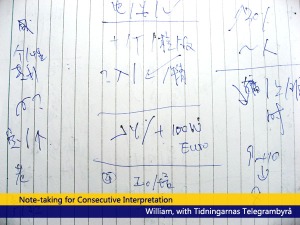
notes as they take in the
source utterance. These notes help the interpreter retrieve the
message from their long-term memory and consist of, “symbols, arrows,
and a key word here or there” (Seleskovitch, 1991 : 7). These few notes
are effective because interpreters do not produce their target texts
based on the form used by the speaker but on what they understood of the
meaning of the source text. The “key words” may consist of words that
will remind the interpreter of the speaker’s point, or of specific
information “such as proper names, headings and certain numbers”
(Seleskovitch, 1978 : 36).
Taking note in consecutive interpreting will be discussed further in the next Section.
Wei HeZhong, in the article
Memory Training in Interpreting views
consecutive interpreting as a process consisting of two separable
phases. The first phase is listening during which the interpreter
listens to the sourcelanguage speech and takes notes; the second phase
is reformulating, during which the interpreter reproduce a
target-language speech from memory and from notes.
- a. Phase One- Listening Phase:
CI = L (listening) + M (short-term memory) + N (note-taking)
In this phase, the interpreter is required to listen attentively,
selectively and actively to the original speech, then the interpreter’s
short-term memory is used to store the messages that have been heard to
put them either in memory or in notes or both. It is easy to recognize
that note-taking is an undivided part of the first phase.
- b. Phase Two- Reformulation Phase:
CI = R (remember) + R (read the notes) + P (produce the speech in the target language)
In the second phase, the interpreter retrieves messages from their
memory as well as from the notes, and produces the speech in the target
language.
2.2. Skills Requirement in Consecutive Interpreting
According to Jones (2002: 5-6), a consecutive interpreter “
listens to the totally of a speaker’s comment, or at least a significant passage, and then reconstitutes the speech with the help of notes taking while listening; the interpreter is thus speaking consecutively to the original speaker, hence the name”. Thus, there are three main skills that have to be mastered by a good consecutive interpreter i.e. :
- Listening Skill
As what has been explained before, Listening Phase is the first phase
to do in consecutive interpreting. Listening is an activity of paying
attention to what speaker say and trying to work out what they mean.
Listening requires full focus, engagement, involvement and
comprehension. If comprehension is incomplete, interpreting will not be
complete either, it will not be a success interpreting as comprehension
of the entire meaning is the first condition of interpreting.
- Note Taking
According to Jones (2002 : 39), note-taking is part of the whole
process of consecutive interpreting including: understanding, analysis
and re-expression, and if these activities “
are not done correctly, the best notes in the world will not make a good interpreter”.
In this case, the interpreter may only write down individual words
which are put together forming a meaningless chunk of information. And
if note-taking is separated from the activity of analyzing the speech,
the interpreter may be lost in the information overload. The interpreter
cannot identify what are the main ideas, what are the secondary
elements, and what are the connections between them in order to decide
what should be noted and what should not. Inevitably the notes become
nothing more than a mess, which will definitely push the interpreter in a
very difficult situation later. When looking back notes, the
interpreter cannot have a clear review of the speech content. And this
obviously goes against one of the basic functions of notes.Note taking
will be discussed further on the next Section.
- Speaking
The importance of this final phase of interpreting resides in the
fact that it leads directly to the final product of the process, i.e.
the target speech. It is this speech that reflects the outcome of the
first two phases of the process and shows whether they have been carried
out appropriately or not.
When producing the target text, the interpreter must display the
utmost fluency as if he were expressing his own ideas naturally and
spontaneously in the TL. Over and above this knowledge of TL words,
expressions and formulaic transfers, the interpreter must possess
textual competence in this language, he must be able to produce texts.
Incomplete sentences which do not make sense, and likewise complete
sentences which are totally disconnected and isolated from one another,
do not serve the purpose of interpreting.
3. NOTE TAKING, AN IMPORTANT SKILL TO BE MASTERED
Note taking has been proved to be very useful for the interpreter
working consecutively. Firstly, notes improve concentration; prevent
distraction, thus facilitating the reception and analysis of the speech.
Secondly, notes help the interpreter relieve the memory. Although the
interpreter may have understood the ideas of a speech, he or she cannot
remember every point in the speech because one characteristic of
short-term memory is that it only keeps information for a limited amount
of time, cognitive scientists also show that for nearly all speakers of
all languages, list retention peaks at around seven items, plus or
minus two. By recording the specific details and data such as proper
names, numbers, figures, lists of things, or specialized terms,
technical expressions, etc, notes release the interpreter from bearing
the whole thing in mind. Thirdly, notes activate the memory of the
interpreter with cues or signals that call up the information in the
speech. With notes, the main ideas, the secondary elements and the links
among them become clear and easier for the interpreter to visualize.
Finally, notes can also be used to highlight missing details,
inconsistencies within the speech and anything implausible that needs
attention latter. Obviously, the skill of note-taking is very helpful to
interpreters, the content and structure of a speech are reflected in
notes, and the notes in turn are used as a path to verbalize the speech.
Thus notes play an important part in consecutive interpreting. However,
taking proper notes needs a lot of practice, and the gap between the
“theory of note-taking” and “actual notes” can be very large. In order
to bridge the gap, first, an understanding of note-taking process is
required.
According to Hanh (2006), the process of note-taking
is not a simple one. In order to make notes become an aid to enhance
consecutive interpreting, the interpreter must answer the three basic
questions as follows: (i) what to note; (ii) how to note; and (iii) when
to note.
(i) What to note
- Main Idea
Notes can be considered as the frame outline of the speech shaped with
main ideas
and the links between them. It is crucial for an interpreter to have
the ability to identify, select and retain important ideas and omit
anything which is not relevant to the understanding of the original
speech. Moreover, the interpreter can easily trace back the structure of
the speech; hardly misses out important ideas; and always keeps
fidelity to the original content by recording the main ideas in notes.
- Links Between Ideas
The links between ideas
is the following thing the
interpreter should consider in note taking. The relations between
individual ideas influence the overall meaning of the text. Thus it is
obvious that the interpreter should realize and render the such links.
According to Jones in Hanh (2006), the ways in which ideas may be linked
together are :
(i) the logical consequence which is expressed clearly with words such as
consequently, as a result, accordingly or
therefore;
(ii) the logical cause which can be recognized with the words
because, due to, as, or
since;
(iii) opposition which often goes with
but, yet, however or
nevertheless
- Verb Tense
According to Jones, it is also important to note down
tenses of verbs. That means “
when
noting verbs, interpreters should thus take care to note the tense
correctly, and if appropriate the mode, in particular conditional”. The modes and tenses of verbs
have decisive influence on the meaning of a sentence.
(ii). How to Note
How to note is also very important. Obviously, notes that are clearly
separated and logically organized help the interpreter avoid all
confusion when reading back notes. And notes using abbreviations and
symbols are very helpful in activating the most information with the
least effort.
- Abbreviation
To take notes quickly, the interpreter can use abbreviations.
Additionally, abbreviations can also help the interpreter in saving time
spent on other activities in the process of interpreting. In order for
the interpreter to understand immediately when reading back notes, these
abbreviations must be definitive and unambiguous because under time
pressure the interpreter has no chance to reconsider the meaning of
abbreviations.
According to Hanh (2006), there are many principles and rules for the
use of abbreviations.The following suggestions about creating
abbreviations are based on the truth that the fewer strokes are written;
the more time can be saved.
- Write what is heard: The interpreter can write a word by recording its sound only.
For example: high-
hi; know-
no; free-
fre; fee-
fe; night-
nite; etc.
- Drop medial vowels:
For example: build-
bld; legal-
lgl; bulletin-
bltn; save
- sv; budget-
bjt etc.
- Write initial and final vowels:
For example: office-
ofs; easy-
ez; follow-
flo; value-
vlu; open-
opn; etc
Abbreviation of common international organization should be
remembered by the interpreter. The interpreter must have some background
knowledge about it. The following are some common names in abbreviation
:
World Bank WB
European Union EU
Asian Development Bank ADB
World Trade Organization WTO
World Health Organization WHO
International Monetary Fund IMF
United Nations Children’s Fund UNICEF
North Atlantic Treaty Organization NATO
Food and Agriculture Organization FAO
Asia-Pacific Economic Cooperation APEC
b. Symbols
A symbol is something such as an
object,
picture, written
word,
sound,
or particular mark that represents something else by association,
resemblance, or convention. Symbols are quicker and easier to write than
words. Similar to abbreviations, firstly symbols need to be prepared in
advance. Any symbol improvised in the middle of interpretation could
drive the interpreter into a difficult and intense situation. One basic
rule for the interpreter: only use the symbols which are already stuck
in the mind. Secondly, symbols must be consistent. That means symbols
are instantly associated for the interpreter himself with the meaning he
gives them. Attending to this point, the interpreter can avoid
mistakenly “deciphering” the meaning of the symbols he or she uses.
Followings are some symbol examples retrieved from electronic source at
Interpreter Training Resource.
The most important of all, abbreviation must be well understood by the member of interpreter’s group.
(iii) When to Note
An interpreter should know when to take notes.It is a very important
and also tough decision that requires the interpreter to arrive at
properly and wisely. Interpreters should start the notes as soon as
possible without having to wait for a complete “unit of meaning”.
Therefore, when the interpreter can sense the meaning of a sentence
which might has not been completed, he or she should note it down. Here
the interpreter has the ability to “forecast” or “feel” upcoming things.
Besides the interpreter is not required to take everything exactly the
same way as the speaker, his or her notes are not presented in exact
order as they were said by the speaker, so there is no need for the
interpreter to wait until the speaker finishes an utterance to take
note. It is also worth mentioning that as soon as speakers finish their
utterance(s), the interpreter should stop taking notes instantly and
start reproducing ideas. If the interpreter is too preoccupied with
notes, he or she will delay the interpretation, which is not wanted. The
interpreter cannot afford to take longer than the speaker. He or she is
expected to react immediately after the speaker has finished.
4. CONCLUSION
Interpreting is like a gap-bridge of language barrier in cross cultural communication.
The goal of interpretation is to convey a message that make the same
impact on the target audience that a speaker/signer intends for an
audience of her/his same language. The different situations where
interpretation takes place make very different demands of the
interpreter. According to Hatim and Mason, there are three major modes
of interpreting i.e. : (i) Simultaneous Interpreting (ii) Consecutive
Interpreting and (iii) Liaison Interpreting. Among the three modes,
consecutive interpreting is widely used both in formal and informal
occasion. There are three basic skill requirements in consecutive
interpreting namely Listening (Understanding), Note Taking (Analysing)
and Speaking (Re-Expressing). The skill that only occur in consecutive
interpreting is Note Taking. It is an importance skill to be mastered.
In order to be able to take notes effectively, an interpreter should
have a comprehension on three basic requirements of note-taking as
follows : (i) what to note; (ii) how to note; and (iii) when to note
REFERENCES
Hanh, Pham Hong. 2006. NOTE-TAKING IN CONSECUTIVE INTERPRETING ENGLISH. HANOI UNIVERSITY OF FOREIGN STUDIES
Hatim, Basil and Mason, Ian. 1999. The Translator as Communicator. Routledge : New York
http://interpreters.free.fr/consecnotes/symbolexamples2.htm
Jones, R.2002. –
Conference Interpreting Explained, St. Jerome Publishing.
Nolan, James. 2005. Interpretation Techniques and Exercises. Multilingual Matters Ltd : New York
Rozan, J. F.2006.
7 Principles of Note-taking, Interpreter Training Resources, n.d. From
http://interpreters.free.fr/consecnotes/rozan7principles.doc
Santiago, R.-
Consecutive Interpreting: A Brief Review, 2004. From
http://home.earthlink.net/~terperto/id16.html
Seleskovitch, D. (1978a).
Interpreting for International Conferences. Washington, DC: Pen & Booth.
Seleskovitch, D. 1991.
Fundamentals of the interpretive theory of translation, in Expanding Horizons. Proceedings of the 12
th National RID Convention 1991, RID Press,
Smith, F. 1985,
Reading Without Nonsense, NY Teacher’s College Press : New York
Wei, H.Z.2003.
Memory in Interpreting, Translation Journal, Volume 7, No. 3, Retrieved March, 24, 2006, from
http://accurapid.com/journal/25interpret.htm
Source: http://goresanpenakoe.wordpress.com


 Once
you're booted into Ubuntu, just choose "Install Ubuntu" from the menu,
and choose your desired hard drive from the list when prompted.
Remember, you want the drive to be empty before you install Ubuntu, so
it doesn't overwrite your data. Also, when you create your user, make
sure you set Ubuntu to automatically log you in. You don't want to have
to type your password every time you reboot your server.
Once
you're booted into Ubuntu, just choose "Install Ubuntu" from the menu,
and choose your desired hard drive from the list when prompted.
Remember, you want the drive to be empty before you install Ubuntu, so
it doesn't overwrite your data. Also, when you create your user, make
sure you set Ubuntu to automatically log you in. You don't want to have
to type your password every time you reboot your server.


 Posts
Posts


